Arrived. Just Not Where You Expected.
On happiness, hedonic adaptation, and learning to notice what's already here
I took my Crocs off in the middle of a forest trail.
The sun was unusually warm for the time of year. I was alone — my family somewhere behind me, far enough that I couldn't hear them. I'd carved out one of those hours that belong entirely to yourself.
My bare feet touched the narrow path. It had been worn into the earth by years of walkers before me, barely wider than a foot. The ground was covered in pine needles and cones. I felt every single one. It didn't hurt. But it made me completely present — in every inch of my body, in every step.
I stood there and thought: this is it. This is when I'm happiest.
Not when I close a deal. Not when something ships. Not at the finish line of anything I'd been chasing. Here. Barefoot. Alone with the pines.
I'd spent weeks turning over the same question — whether to leave my job. Six months earlier I had loved it. Then something shifted. Small irritations started feeling enormous. I was more anxious than usual, less clear than usual, and somewhere deep, I already knew the answer. I just wasn't ready to say it out loud yet.
Arrived. Just Not Where You Expected. On happiness, hedonic adaptation, and learning to notice what's already here.
Travelling on a sofa.
We took the bus everywhere when I was a child.
Packed, airless, they smelled. I almost always felt sick. On rare summer trips to my aunt's cottage — forty kilometres out of the city — she'd sometimes take a taxi. Once, maybe twice a season. I fell in love with those rides. The back seat was wide and cool. We moved faster than a bus, without stopping every three minutes for someone else's schedule. The window cracked open slightly. Sun on the road ahead. No one's sour breath nearby.
It felt like travelling on a sofa that someone had pointed at the horizon and said: go.
Hedonic adaptation.
There's a concept I keep returning to — hedonic adaptation. My brain isn't built for sustained satisfaction. It's built for contrast. For noticing change, not states. You get the thing. The brain registers it, produces a response, recalibrates. New baseline. And then it goes looking for the next gap to close.
This isn't a character flaw. It seems to be the architecture. A mind that stayed permanently satisfied would stop improving, stop solving. Dissatisfaction is the engine.
The problem — as I understand it — is that nobody mentioned this when they were selling us the dream.
I grew up around people who used one phrase more than almost any other:
If I had a…
If I had a little more.
If the pension would go up.
Nobody was sitting still — people worked multiple jobs, grew vegetables, scraped together what they could. But the mental model underneath was the same: happiness is a destination. The ticket is money, luck, or someone deciding to hand you a different life.
The idea that you could think your way into a different relationship with your own life — that wasn't part of the vocabulary. Not where I grew up.
Lottery winners report the same happiness levels eighteen months after their win as people who won nothing. Americans' average happiness scores barely shifted between 1940 and 1990 — a period when disposable income more than tripled. The treadmill adjusts its speed to match you. That seems to be its only function.
None of this sounds like someone who has ever had nothing. So let me be clear about that.
It wasn't always.
The safety net.
There was a period when I couldn't pay rent. The sofa bar had closed six months earlier. The relationship had ended a month after that. I didn't give myself time to process any of it. I threw myself into a new project immediately — which was how I ran from things I wasn't ready to feel. That project didn't give me what I'd hoped. I was living off savings that were nearly gone, selling things I no longer needed — suits, camera equipment, anything with a resale value — to cover bills.
There was shame in it. More than I admitted at the time, even to myself. The decisions that led there weren't all bad luck — some of them were mine, clearly mine, and I knew it.
The decision to give up the apartment and move back to my childhood home was obvious, if not easy. I'd been through versions of this before, and I knew that delaying would only make it worse. I didn't regret it. But I felt, standing in that empty flat, that I was starting from scratch. That the answers would have to come from somewhere inside me, because there was nowhere else to look. In retrospect, that forced pause — as hard as it was — was one of the better things that happened to me. I hadn't let myself stop until the stopping was no longer optional.
The safety net I have now is something I built slowly, over years, with more mistakes than I'd like to count and a handful of decisions that turned out to be right. It would last me a little while if everything stopped tomorrow. Not a long time. Not a lifetime. It may sound like enough — until you start doing the arithmetic.
And now there's a child. Which means I have considerably more to lose than I did the last time I had nothing.
Waves of life.
Careers move in waves. So does everything else. I misunderstood this for a long time — I thought the high tide was the destination. When the deals closed and the money arrived, the instinct was to expand. To match the moment. We are told to live in the now. We mistake that for spending in the now.
But the high tide is exactly when you build the reserve. Not to fund a bigger future — to buy yourself the right to pause when the tide goes out. Because it always goes out. The money you set aside during the good years isn't savings. It's the price of admission for the months when you'll burn out, lose the thread, and need to stand barefoot in the dirt again without a rent payment arriving in three weeks.
I didn't understand this in time. I do now.
The trap.
There is a quieter trap underneath all of this. We are wired to mistake the satisfaction of desire for happiness. You want the thing. You get the thing. Something spikes. You call it joy. It isn't. It's just the loop completing itself.
Lately — in the pauses I've forced on myself — I've noticed the wanting getting quieter. Not because what I have is enough in some absolute sense. But because something in me has started to understand that closing the gap doesn't close anything. It just opens the next one.
The first time the wanting goes quiet, it doesn't feel like peace. It feels like emptiness. Like the engine stopped, and nobody told you how to drive without it. It takes time to understand that the emptiness isn't the absence of life. It's the room where life actually fits.
Gratitude.
For a long time, I confused gratitude with resignation.
When I first encountered the Dalai Lama, my reaction was close to suspicion. All this contentment. All this acceptance. It sounded like the people I grew up around — resigned to their circumstances, calling it peace. The word gratitude carried the smell of defeat.
I've since changed my mind. Slowly.
Resignation contains surrender. It says: this is my lot. It usually carries a quiet self-betrayal — the belief that you don't deserve better. That's not gratitude. That's fear dressed in humble clothing.
Genuine gratitude doesn't require you to stop wanting things. I have a coffee machine I saved up for and bought deliberately — not expensive, not cheap, exactly right for what I wanted from it. Every morning, I grind fresh beans I order from Denmark, steam the milk into something silky, and try to draw a pattern in the cup. It's a small ritual. It cost me less than a single dinner out. I'm genuinely grateful for it.
And somewhere in the back of my mind, I'd like a different car someday. Something newer, something that fits a slightly different version of who I'm becoming. Both of these things are true simultaneously. The coffee machine doesn't cancel the ambition. The ambition doesn't poison the coffee.
What toxic gratitude does — what forced gratitude does — is demand that you feel only the first thing and suppress the second. It says: Be thankful for what you have and stop wanting more. Which sounds noble until you realise it's just another way of telling people to stay put.
A direction and a fixation are not the same thing, even if they look similar from the outside. A direction is a vague pull toward something better — not every detail planned, not every criterion locked in. A fixation is the refusal to arrive anywhere except the exact destination you imagined. The trouble with fixations is that the destination rarely looks the way you expected. The direction, on the other hand, often takes you somewhere you couldn't have planned — and turns out to be better.
Stoicism doesn't require you to drink bad wine for the rest of your life. It asks that you not be owned by the desire for better wine. There's a difference. A small one, maybe. But it's where most of the freedom lives.
Philosophy of joy & happiness.
What I've taken from Brené Brown — who spent years interviewing people about joy — is something that surprised me when I first read it. She expected to find that joyful people were grateful because good things had happened to them. The equation was reversed: gratitude came first. People who described themselves as genuinely joyful shared one thing — a practice. Not a feeling. Something done deliberately, not just felt occasionally.
She also writes about what she calls foreboding joy — the way many of us preemptively rehearse the loss to soften the blow. You stand over a sleeping child and feel something enormous — and immediately picture something going wrong. I know this one. It's a defence. Gratitude, in her reading, is the antidote. Not a recipe for happiness. An antidote to that particular fear.
Marcus Aurelius arrived somewhere similar. What he wrote — in private notebooks never intended for anyone else — reads less like philosophy and more like a man reminding himself of things he kept forgetting. Don't hate people. Don't let the ego grow. Pay attention. Be here. The same notes, over and over. A man fighting the same battles the rest of us fight, with considerably more power and apparently not much more natural immunity to distraction.
That's the most honest version of this I've found.
Not achievement.
Repetition.
The same reminders, daily, until you die.
What I've come to understand — gradually, imperfectly, still failing at it regularly — is that happiness isn't something that arrives from outside.
It's a state you learn to generate. Not by pretending things are fine when they aren't. By training your attention toward what is already here, while the rest of life does what it does.
This process doesn't finish.
The now.
I have a few hours most mornings that belong only to me.
I sit with them. I watch the light come in. I notice the cypress hedges around the house — tall and dense. I hear birds. I drink the first coffee of the morning, which tastes better than every cup that follows.
My son is asleep in the next room.
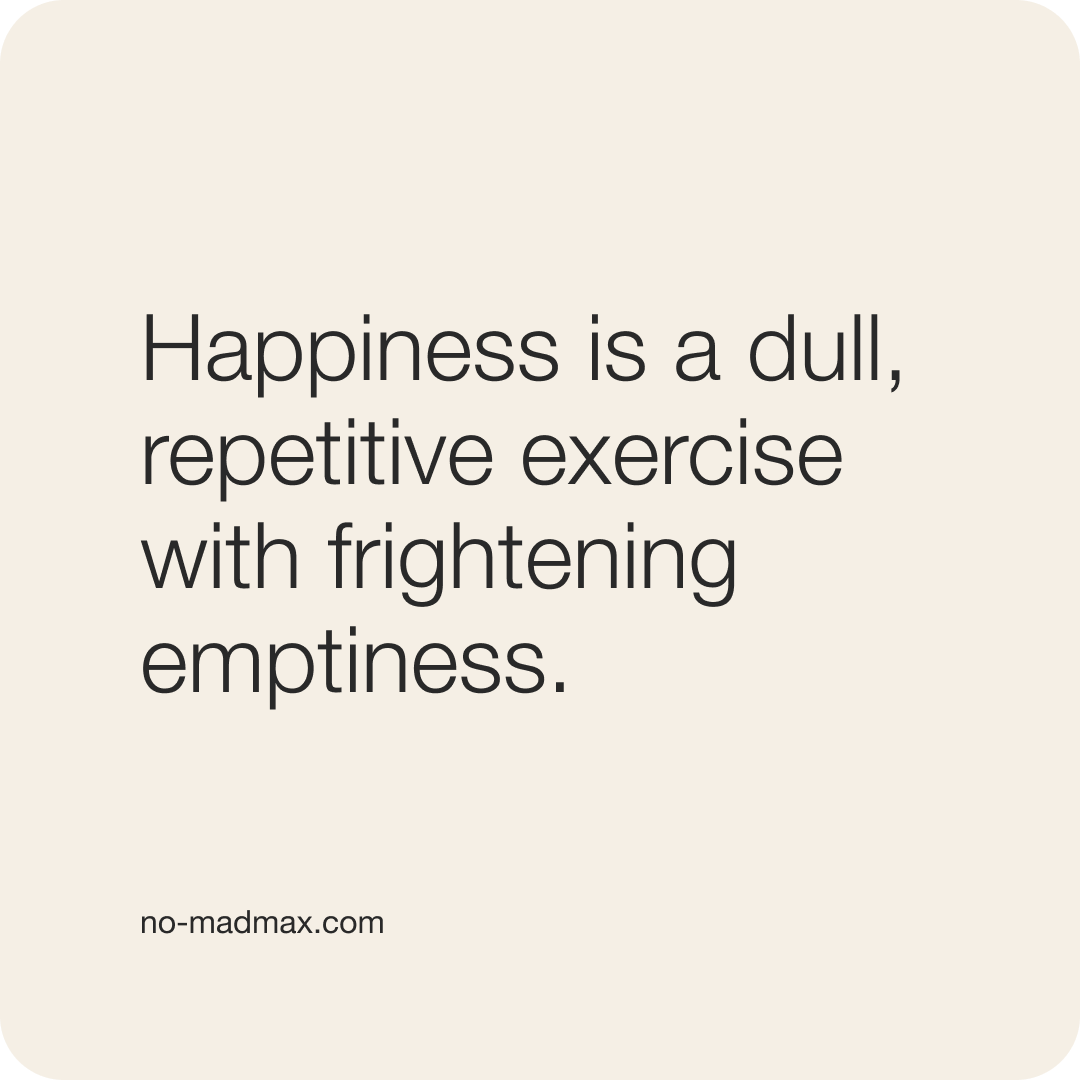
Happiness is a dull, repetitive exercise that requires sitting with frightening emptiness long enough for it to stop frightening you.
Happiness is sitting with frightening emptiness until it stops. I write about mechanisms and how happiness actually works. I am the guinea pig in these live experiments. You can also find me on Substack and Medium.
